Why You End Up The “Bad Guy” in Your Own HousePost
Why You End Up The “Bad Guy” in Your Own House
You enforced a fair rule calmly, and somehow you're still the bad guy. There's a reason for that, and it isn't your tone.
By: Michael Barsamian
It's nine at night and their homework isn't done, but the phone is still in her hand, and you say what most of us parents have said too many times before. “Give me your phone. Why isn’t your homework done? It’s almost time for bed. What have you been doing?”
She looks up at you like you have just taken something precious and personal from her. Here’s the problem - she doesn’t see you keeping a rule, just that you took something of hers.
And in the next ninety seconds you are the meanest mom in America, “nobody else's parents do this” she argues and then says she can't wait to leave. You didn't raise your voice, you weren't unfair. You simply said the same thing you’ve said before.
But, you still ended up the bad guy.
Here's the part I want you to hear before anything else. Usually, this is not happening because you’re doing it wrong. You’re not too strict. You are likely pretty consistent (and even give some extra time on the phone occasionally). You’ve read the books, you’ve tried using a calm voice, and you’ve tried a firm voice, and you have watched both of them end in the same argument and a slammed door.
Something else is going on, and once you see it you’ll know exactly what to do from now on.
But first, let’s agree to stop doing three things at once - because here's what you are actually doing in that hallway, late at night.
One, you’re explaining the rule (again). Two, you are enforcing the rule. Three, you are lecturing as the judge about the violation. All at once. All by yourself. In the middle of the moment when your teen is least able to hear any of it.
Think about what that looks like from where she’s sitting. The rule came in the same breath as the punishment, delivered by the person she hates to argue with. She has no way to separate the rule from you. So she does the only thing available to her.
She argues with you and distances herself because (to her) you have become the source of her pain and frustration.
Here’s the real problem. There is no agreed on family standard to argue with. There is only you, standing in a doorway, being the reason her night just changed. Here’s why I say standard. A standard is the behavior that comes from a value we hold as a family. A boundary is the limit at which that standard expires. “Rules” keep you from getting too close to, and crossing a boundary.
Here’s an example. If a family value is respect, the standard would be “we speak to each other in respectful ways with kindness and honesty.” The boundary would be when something disrespectful is said in conversation or conflict. A rule would be, “No cussing, lying, or insulting.”
Families focus on rules when they should have values, standards, and boundaries everyone has agreed on first.
This is why the calm voice doesn't save you. Tone isn’t the issue. You can deliver a perfect sentence and still be the “thing” your teen is pushing against, because in that moment, unfortunate for you, you are the issue in their eyes.
Notice who the referee never becomes
We’re a soccer family, have you watched a soccer game? The referee makes an offside call, the crowd boos, a player throws his hands up, and eleven seconds later the game restarts.
Nobody storms off because nobody stops believing in offsides.
The referee is not hated for the offside rule, because he did not write it. It existed before the game. Everyone on that field agreed to play under it before anyone laced a boot. The referee only points at something that was already true.
Now imagine a ref who invents rules during the game. That pass was too long. That celebration was too loud. The game stops being a game. It becomes about him. Every call is now a debate on whether he’s fair, and every player is now arguing with a person instead of a standard.
Most of us have felt like that second referee, that’s you at nine at night. Not because you’re unfair, just because the rule and the person are arriving at the same time, in the same voice, and your teenager has no way to tell them apart.
What makes a teenager follow a rule?
A study published in the Journal of Youth and Adolescence followed 218 parent-child pairs across two school years, looking at what actually predicted whether kids followed their parents' rules. Here’s what grabbed my attention: the strongest predictor was whether the child saw the rule as legitimate. Kids who viewed their parents' rules as legitimate complied significantly more than kids who didn't.
But here's the second half, and it’s important because it stands against so-called “soft parenting”. The same study found that kids complied more when parents made decisions with real authority and responded to disagreement by holding firm on the standard rather than wavering.
Read those two findings together and you get something most parents miss.
This was never a choice between being firm and being liked. Agreement and compliance run on legitimacy plus follow-through. Your teenager needs the standard and rule to make sense to her and she needs you not to fold when she pushes against it.
The problem is that you have been trying to establish legitimacy at the worst possible time - in the heat of conflict late at night.
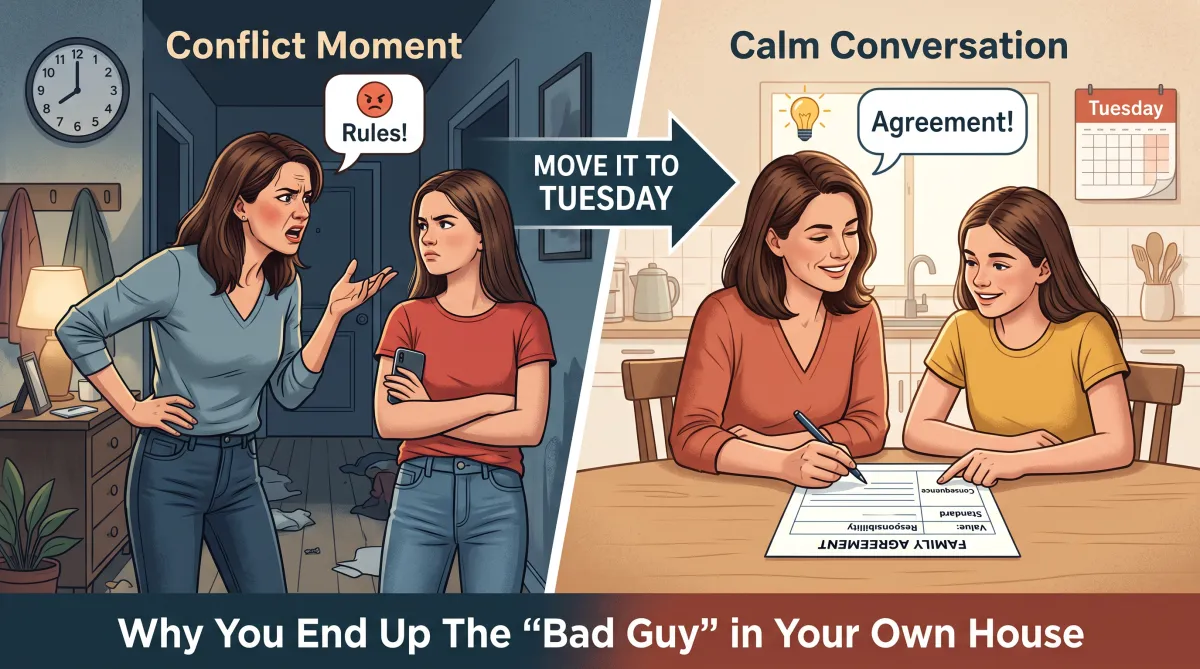
Move the argument to Tuesday
Here is the whole change, and it’s pretty simple.
Have the conversation about the standard when nothing is happening.
Not at nine at night. Not during the fight. On an ordinary Tuesday, in the car or at the table, when nobody is in trouble and nothing is at stake. You talk side-by-side and build the standard together, out loud, before you ever have to enforce it.
Four things go into that conversation.
What the standard actually is. “We finish what we're responsible for before we relax" is the standard, and "homework before screens" is the rule that keeps you off the boundary.
Why it exists. State the value "As a family we value responsibility - I've watched what happens to your sleep when you’re up too late and stress over your homework not getting done and it’s not fair to you.”
What she thinks. This is the part people skip and it is the part that does the maturing work. Ask her. “What feels unreasonable about that? Do you think something needs to change?”
What happens when it doesn't happen. This is what keeps her growing and keeps you from being the bad guy. There’s agreement in advance, by both of you, out loud. I use a system with my boys and clients called the Mature Matrix. It’s a simple grid that links each action to the consequence she helped choose.
Then, at nine at night on some Thursday three weeks later, when the homework isn't done and the phone is still in her hand, the sentence you say is completely different.
Not "give me the phone."
"What's our agreement on homework?"
You are not the author anymore. You are not the judge. You are the person pointing at something the two of you built together on a calm Tuesday when nobody was angry. She can be annoyed at the standard. She can be annoyed at herself. She cannot easily make it about you, because you are not the one who made it up.
You stopped being the bad guy by getting out of the middle of it.
Make peace with what this is not
I want to name three things clearly.
One, this is not permissiveness. Nothing here loosens a boundary. The standard is the same standard, the consequence is the same consequence, and you hold both. That research found that wavering makes things worse, and I agree with it. This changes when the agreement gets made, not whether you enforce it.
Two, this is not negotiating in the moment. The whole point is that the negotiation already happened, on a day when both of you were calm. If you find yourself re-opening the terms at nine at night, you have gone back to being the second referee. The answer in the moment is "we can talk about the rule on Saturday, tonight it stands, that’s what we agreed on."
Three, your teenager does not get to write the rules. You are still the parent, and some standards are not up for discussion, especially around safety. But there is a wide space between she decides and she participates and contributes, and almost everything you fight about lives in that space.
Expect it to take longer than one Tuesday
Two honest things before you go try this.
The first conversation will probably be awkward. If your teenager has spent two years experiencing rules as things that get done to her, an invitation to help build one will be met with suspicion. That is a reasonable response to her actual experience, and it is not a sign this won't work. Do it anyway. Take your time and help her understand the “why” of having values and standards.
This is about disconnection and conflict, not about crisis. If what is happening in your house is closer to your teenager's safety than to her attitude, that is a different conversation and a different professional. I'm a coach, not a clinician. If any part of her safety is a concern, call your pediatrician or a therapist, today.
What actually changes
The thing I most want you to take from this is not a technique.
It's that the exhaustion you feel is not evidence that you are bad at parenting. You have been carrying three jobs that were never meant to be held by one person in one moment, and you have been doing it at the worst hour of the day, for years, and you have kept showing up anyway.
That is not failure. That is a structural problem with a structural fix.
Move the agreement earlier. Let her have a real hand in it. Then hold the line without flinching, because the line isn't yours to hold alone anymore, and in the teen years almost nothing is.
You don't have to be the bad guy to be the parent. You just have to stop being the only thing in the room to argue with.
Mike Barsamian coaches parents of teenagers and created the PACE Setter Method™ — a four-part framework built on the idea that a parent's job in the teen years is not to run the race but to set the pace. He has worked with teens and families since 2003, holds an M.A. in theology from Fuller Theological Seminary, and is a licensed and commissioned pastor. He writes at PresentSolutionForParents.com.


